Navigating the Global SAF Registry: A Technical & Compliance Roadmap for Aviation
Unlock the 'Book & Claim' mechanism safely. A step-by-step guide to achieving IATA SAFSG Registry compliance by building reliable, auditable data pipelines.
The Sustainable Aviation Fuel (SAF) Registry, managed by the Civil Aviation Decarbonization Organization (CADO), is a pivotal step towards aviation's Net Zero 2050 goal. Its purpose is simple but its technical execution is complex: it creates a global, standardized, and transparent system for tracking SAF transactions.
For airlines and their corporate customers, the Registry is the definitive answer to the 'double-counting' problem, ensuring the environmental attributes of SAF purchases are recorded immutably. However, successful compliance is not a matter of paperwork; it is a data engineering challenge that requires connecting highly segregated operational and financial systems.
Pillar 1: Understanding the 'Book & Claim' Mechanism
The core concept enabled by the Registry is Book & Claim. Because SAF is scarce and not available at every airport, an airline can purchase SAF in one location ('Book' the environmental attributes) while consuming conventional jet fuel in another location ('Claim' the emission reduction benefit).
The Registry makes this possible by creating an electronic record for every gallon of SAF's environmental benefit. This mechanism is essential for scaling the SAF market globally, but it places the onus on the airline to provide unimpeachable data to the Registry to prove the transaction and benefit claim.
Pillar 2: The Technical Challenge – Unifying Disparate Data
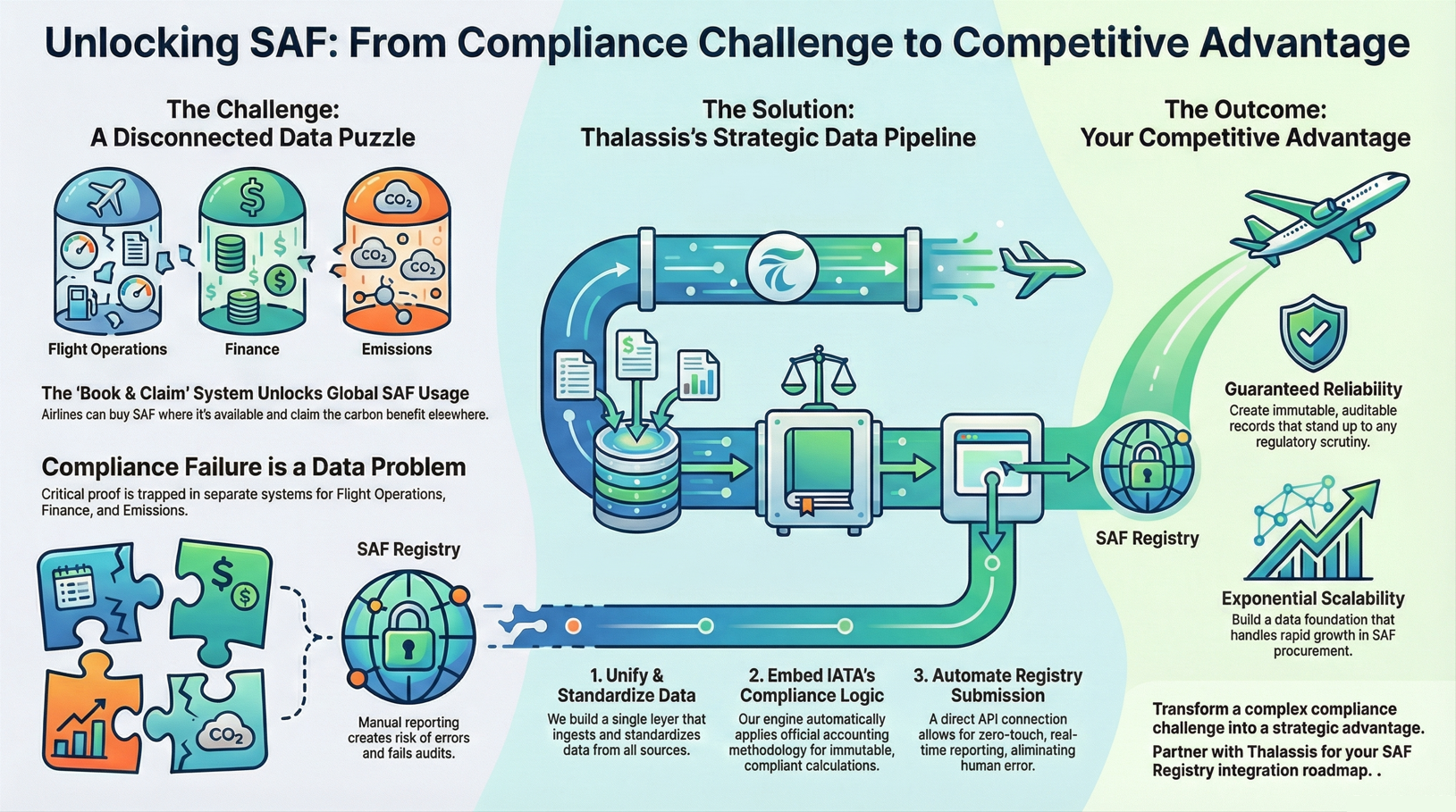
Compliance failure often occurs because the required data resides in three separate, often legacy, systems:
1. Flight Operations Data (EFB/Flight Planning): Records the actual flight path, fuel uplift, and consumption—crucial for defining the claim boundary.
2. Procurement & Financial Data (ERP/Accounting): Records the SAF purchase contract and transaction details—crucial for verifying the Book event.
3. Emissions/GHG Inventory Systems: The old system where the claim is actually made against a carbon budget (CORSIA or voluntary goal).
The technical gap is the lack of an automated, trusted data pipeline that can link the operational proof (consumption) with the financial proof (purchase) to generate the required Registry submission package.
Pillar 3: Thalassis's Strategic Data Pipeline for Registry Interoperability
We specialize in designing and implementing the robust data architecture required for seamless SAF Registry compliance. Our approach focuses on three steps:
1. Data Abstraction Layer: We build a normalized layer that ingests and standardizes data from all source systems (e.g., EFB, SAP, internal ledgers). This eliminates manual data entry and fragmentation.
2. IATA Methodology Engine: We embed the IATA SAF Accounting and Reporting Methodology logic directly into the pipeline. This ensures that emissions calculations are globally harmonized, immutable, and compliant with CORSIA standards before submission.
3. Automated API Interface: We configure the final pipe to communicate directly with the Registry's APIs. This allows for zero-touch, real-time submission of claims and transactions, mitigating the risk of human error and ensuring immediate compliance visibility.
Conclusion: Turning Compliance into Competitive Advantage
The SAF Registry is not just a regulatory hurdle; it's a foundation for a future, more transparent energy market. By automating the data flow and ensuring auditable governance, you gain:
Guaranteed Reliability: Immutable records that stand up to regulatory scrutiny.
Exponential Scalability: A foundation that can handle rapid growth in SAF procurement and future, more complex reporting mandates.
Partner with Thalassis to transform this complex compliance challenge into an opportunity for strategic leadership in the decarbonization race. Contact us to discuss your SAF Registry integration roadmap.