Cloud FinOps: How to Eliminate Runaway Cloud Costs and Guarantee ROI on Azure/AWS Migration
Establish financial accountability for cloud spending. Implement FinOps practices, automation, and governance to turn unpredictable bills into predictable, optimized business value.
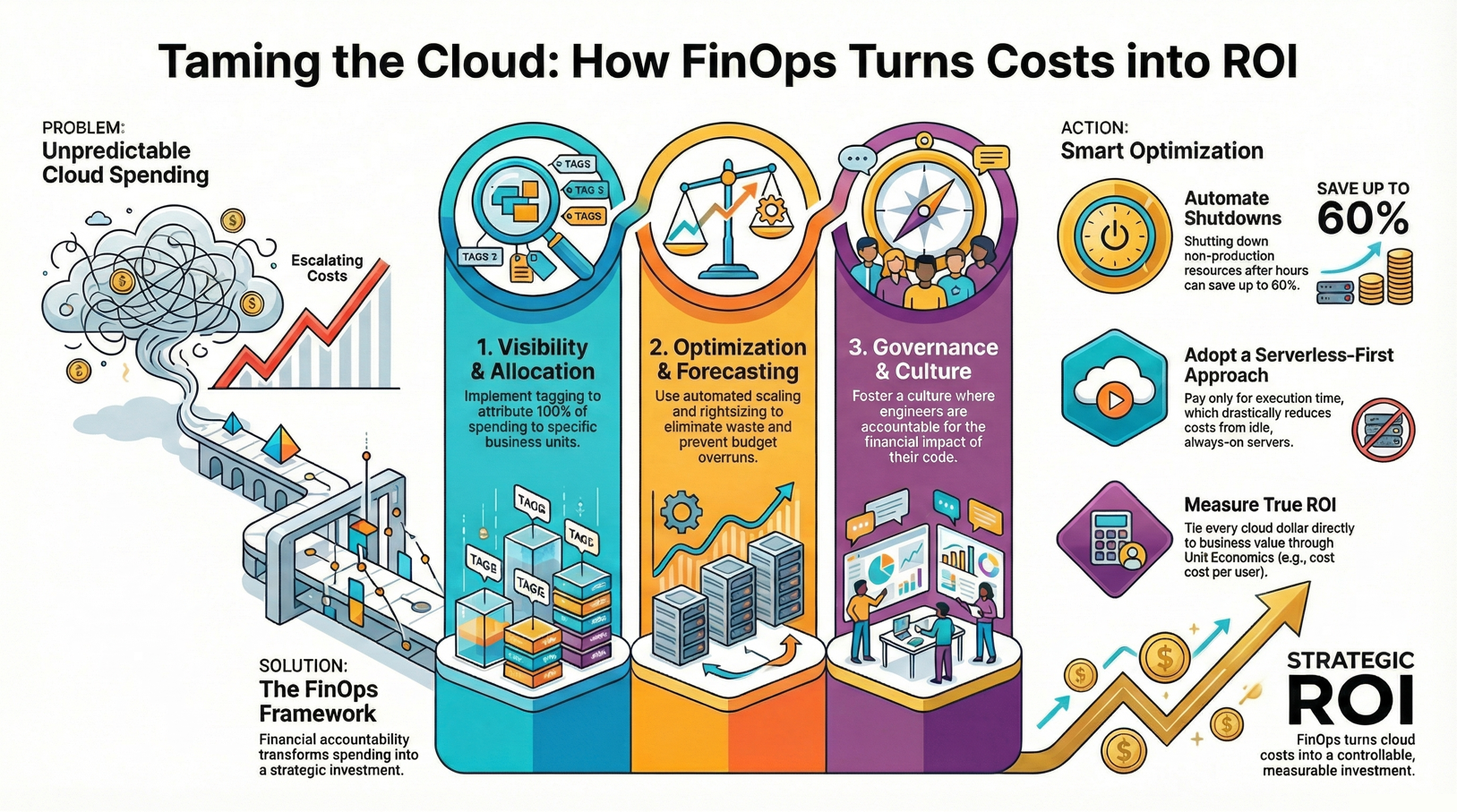
The move to the Cloud promises flexibility and efficiency, but without strict governance, it often delivers the opposite: unpredictable and rapidly escalating costs. This is the reality of many large migrations where infrastructure is optimized for technical performance but not for financial efficiency.
FinOps (Cloud Financial Operations) is the necessary culture, process, and technology required to bring financial accountability to the variable spending of the Cloud. It transforms cloud cost from an uncontrolled expense into a strategic, measurable business unit.
The Three Pillars of Financial Accountability in the Cloud
FinOps is not just about cost reduction; it’s about making smarter engineering decisions driven by cost visibility. We focus on integrating three foundational pillars:
1. Visibility and Allocation: You cannot optimize what you cannot see. We implement tools and tagging strategies to ensure 100% resource allocation, enabling teams to instantly attribute spending to specific business units or products.
2. Optimization and Forecasting: Utilizing tools like Reserved Instances (RIs) or Savings Plans, automated scaling policies, and rightsizing resources to eliminate waste. Accurate forecasting prevents budget overruns.
3. Governance and Culture: Establishing a 'Cloud Cost Czar' and mandatory reporting cycles. Crucially, fostering a culture where every engineer is accountable for the financial impact of their deployments.
Technical Deep Dive: Automation for Cost Elimination
Optimization must be automated to be effective at scale. We focus on deploying self-healing and self-optimizing architectures:
Auto-Shutdown Policies: Automatically identifying and decommissioning non-production resources (e.g., dev/test environments) outside of business hours, saving up to 60% on non-essential compute.
Serverless First Approach: Prioritizing serverless functions (Lambda, Azure Functions) where you only pay for execution time, drastically reducing idle costs compared to always-on virtual machines.
Intelligent Scaling: Moving beyond simple CPU-based autoscaling to using custom metrics (like message queue length or business transactions per minute) to ensure resources scale up and down precisely when needed, minimizing over-provisioning.
Measuring Success: Turning Spend into Strategic ROI
The goal of FinOps is not simply to have a smaller bill, but to measure the true return on every cloud dollar. Key metrics include:
Cloud Efficiency (CE): Comparing the cost of delivering a service (e.g., cost per customer transaction) month-over-month.
Unit Economics: Tying cloud spend directly to business value (e.g., cost per booked flight, cost per active user).
Thalassis provides the architectural expertise and operational frameworks necessary to ensure your migration to AWS, Azure, or GCP delivers measurable, sustainable ROI, turning cloud spending into a strategic investment, not an uncontrolled liability.